A GPS measuring stick is an important tool in surveying. A GPS measuring stick includes much more than just a stick.
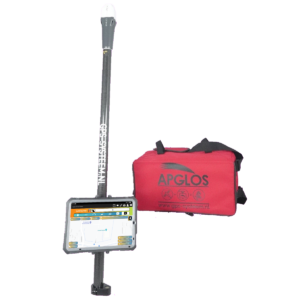
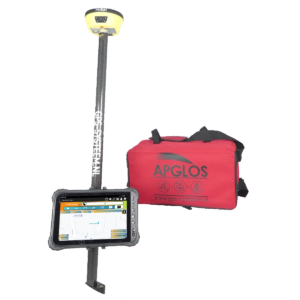
But what is a GPS measuring stick? A GPS surveying stick is a surveying instrument that consists of a GPS receiver, a lead rod, a tablet with surveying software and some other accessories. One uses a GPS measuring stick to accurately measure position using satellite signals.
Knowing this, more questions still arise, such as:
- What does a GPS measuring stick consist of?
- How does a GPS measuring stick work?
- How does a GPS measuring stick differ from a phone with GPS?
- What should you look for when buying a GPS measuring stick?
Buy or try a GPS measuring stick immediately
Maybe you already know the questions to the above questions. And would you like to buy or try a GPS measuring stick right away. Of course you can. On this website you can buy or rent a good, complete GPS measuring system. On these pages you can also request a demonstration of our GPS measuring sticks.
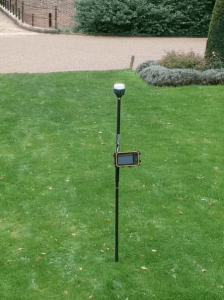
All GPS measuring sticks on this website are professional surveying measuring systems. With the GPS measuring systems on this website, you can obtain the same accuracy as that of any surveyor.
Nevertheless, the GPS measuring sticks rented and sold on this website are easy to use. Before the GPS measuring system is delivered to you, it is already fully set up. In addition, all of our GPS measuring systems include the easiest-to-use surveying software.
This is Apglos Survey Wizard. Should you wish to download only the software you can do so via the Google Play Store. After downloading and registering, you can test this easy-to-use surveying application for free.
What does a GPS measuring stick consist of?
When the word combination GPS measuring stick comes to mind, surely the stick is the most important thing. The stick, which officially has a lead rod, is certainly important because it holds everything together. But in addition to the lead rod, there are several other parts to a GPS surveying system, which are important to perform surveying work.
All the necessary parts for a (network) GPS measuring stick are:
- lead bar
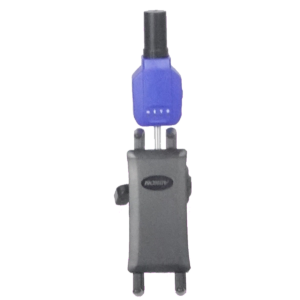
- GPS receiver
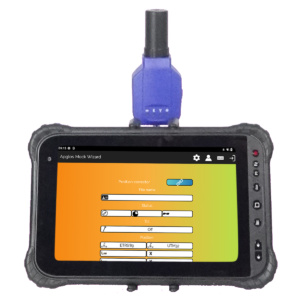
- tablet
- tablet holder
- surveying software
- RTK correction subscription
- data plan
Lead rod
So the lead rod, or actual stick of the GPS measurement system, holds all the parts together. Often the lead rod is carbon fiber, making the total fairly light to carry. The most common lead rod is a screw-on 2-meter pole, which consists of two sections.
But there are other lead bars, such as telescopic poles. These are extendable. There are also aluminum lead bars. These are heavier than the carbon lead rods but sturdier.
On the underside of the lead stick is usually a weighted tip. This makes it easy to place the GPS measuring stick at a specific point to measure.
The lead rod tip does sink in unpaved terrain. Therefore, the pole tip can be replaced with a sand foot. With the use of a sand foot, the GPS measuring stick does not sink into unpaved terrain, allowing unpaved terrain to be measured more accurately.
The lead rod thread is 5/8 inch. This is the most common thread on GPS receivers, making it easy to attach most GPS receivers to the lead rod.
GPS receiver
So on top of the lead rod will be a GPS receiver.
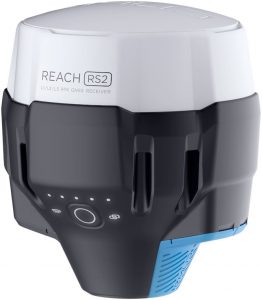
A GPS receiver is the ‘sphere’ on top of the lead rod. This is a very important part because the GPS receiver on the GPS measuring rod receives the satellite signals and converts them to a position in latitude, longitude and altitude.
Without this component, the GPS measuring stick cannot function. However, there are many different GPS receivers. There are already many brands of GPS receivers, such as Trimble, Topcon, Leica, Spectra Geospatial, Septentrio and Emlid.
Then again, most brands have a range of different GPS receivers. Lastly, a type of GPS receiver from a particular brand may have different options. In addition, there are many different price ranges.
It is therefore not so easy to choose a GPS receiver. However, in terms of price-quality ratio, the Emlid Reach RS2 is tremendously special.
This is also the reason that the Emlid Reach RS2 is integrated into the GPS measuring sticks, which you can buy or rent from us. Now it may well be that a rental set comes with a different GPS receiver. However, we always make sure that GPS receiver is of good quality.
Tablet with tablet holder
Even with just a GPS receiver, you can't do much. The position calculated by the GPS does need to be displayed. This requires a tablet, phone or handheld.
The larger the screen is, the larger and the more data can be displayed. That's why our GPS measuring sticks come with a tablet. This is because the screen of a tablet is larger.
The tablet is attached to the lead rod of the GPS measuring stick with the tablet holder. This creates a single unit that makes the GPS measuring system easy to carry with one hand.
Surveying software
The tablet, phone or handheld should have surveying software on it. If you think of the GPS receiver as the eyes and brain of the GPS measuring stick then you can think of the surveying software as the mouth and ears.
The mouth, because the surveying software tells you what data is coming out of the GPS receiver. And the ears, because you can give commands through the surveying software, which are executed.
The easiest software to use with a GPS survey stick is Apglos Survey Wizard.
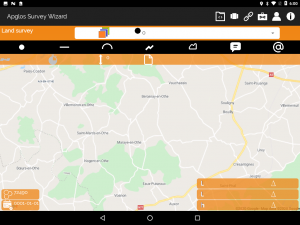
With simple icons, you can measure instantly. You can try this professional land surveying application yourself for free by accessing it through the Google Play Store. download.
RTK correction subscription
And now comes something more difficult. Based only on satellite signals, a GPS receiver cannot quickly determine its exact position.
Because of changes in the atmosphere, there are anomalies. And these deviations must be corrected. The corrections are corrected in to a second GPS receiver at a certain fixed point in the GPS receiver.
Therefore, several RTK correction networks are active in the Netherlands. They transmit the connections to the GPS receiver via the Internet. This does require a subscription.
But when an RTK correction subscription is taken out, one can measure centimeters accurately.
Data plan
So the RTK corrections come via the Internet. This is also the reason that a data subscription is required for your GPS measuring stick. Only, if the GPS receiver can connect to the Internet through the tablet or not, the RTK corrections can be received.
So the data subscription is also an essential part of a GPS measuring stick.
How does a GPS measuring stick work?
Those are all the parts, but that doesn't quite capture how a GPS measuring stick works. GPS stands for Global Positioning System. So it is a system that can determine position around the world.
This positioning is done using satellites. Many satellites fly around the earth. And a small part of them continuously sends where the satellite is. So in that message there is a location and a time.
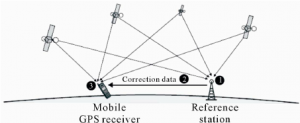
The GPS receiver of the GPS measuring stick receives these signals. And it calculates from the time difference and the speed of the signal, where the GPS receiver is at that moment.
As mentioned, there are anomalies due to the atmosphere. As a result, the speed of satellite signals is not always the same.
So that is why there is the RTK correction network. The RTK correction network consists of several reference stations. A reference station consists of a GPS receiver located at a fixed location that has been measured. This allows the deviation to be determined.
The nearest reference station sends this deviation to the GPS receiver. Using the data sent by the reference station, the GPS receiver of the GPS measuring stick adjusts the position to be centimeter accurate whenever possible.
This allows a GPS measuring stick to determine position very accurately. And that's why the GPS survey stick is also an ideal surveying tool to measure with. It is easy, especially when Apglos Survey Wizard, is part of the GPS surveying system, and it can be used anywhere.
How does a GPS measuring stick differ from a phone with GPS?
Most phones also include a GPS receiver. Still, a phone cannot measure as accurately as a GPS measuring stick.
This is for a number of reasons. First, the GPS receiver in a phone is often not built to provide centimeter-accurate positioning. Phones need to be able to fit in a pocket.
And that's a bit of a contradiction with good reception of satellite signals. In fact, a GPS receiver benefits from a large antenna. The larger the antenna the easier and the more satellite signals the GPS receiver can receive. Often an antenna with a 10 cm diameter disk is sufficient to receive enough satellite signals.
With a phone, however, you cannot make the antenna of the GPS receiver much larger, because the phone will be too big. As a result, a phone is already less accurate than a GPS measuring stick.
But there's one more thing. The phone does not use RTK corrections. As a result, the phone's GPS receiver does not take into account changing conditions in the atmosphere.
As a result, a phone's GPS deviations are much greater than those of a GPS measuring stick. That in itself is not a bad thing, as long as one uses the different devices for the right purposes.
A phone is good to use for navigation, for example with Google Maps. Land surveying, however, becomes a bit more difficult because of the lack of accuracy. Of course, this is always true unless you just want an indication of a particular position.
So with a GPS measuring stick, you can determine position more accurately than with a phone.
What should you look for when buying a GPS measuring stick?
When purchasing a GPS measuring stick, there are a number of things you should be aware of.
First, there is the GPS receiver. As may be clear from this entire story, the GPS receiver is hugely important. But we have also indicated that there are many different GPS receivers. There are GPS receivers that cost more than €10,000. And such receivers are not for everyone.
Therefore, here are some tips to look out for when choosing a GPS receiver:
- For faster operation, choose a GPS receiver that can receive as many GPS signals as possible (L1, L2, L5)
- Choose a GPS receiver that can receive different satellite constellations (GPS, GLONASS, GALILEO, BEIDOU)
- An indication of GPS receiver accuracy can often be found at Precision -> RTK
In addition, it is important to use a certified RTK correction network. The Kadaster certifies the reference stations. Only when the Kadaster has certified the reference station then you can be confident that the received RTK correction signals are correct.
So always ask if the reference stations of the party you want to enter into an RTK correction subscription with are certified, before entering into an agreement. And should the reference stations at that party not be certified by the land registry, look for another party.
Our GPS measuring sticks always include an RTK correction subscription with certified reference stations. Also included with all our GPS measuring systems is the simplest land survey software: Apglos Survey Wizard.
Therefore, this is the last thing you need to consider when buying a GPS measuring stick. Make sure you are going to work with software that you understand. And that chance is greater with Apglos Survey Wizard than with other surveying software.
Want to try a GPS measuring stick yourself?
Of course, you can also try it yourself. To do so, check out this page.
You can decide the number of days of your test period. You will then see immediately if having and using a GPS measuring stick is something for you. This is because you rent all the components of a GPS measuring stick, with no obligation to purchase.
This allows you to test the GPS measurement system on a real project and see if the method of working with a GPS measuring stick works for you in practice.
An added benefit is that you can have multiple people working with the same GPS measuring system, so that you and your colleagues and/or employees can all experience what working with a GPS measuring stick is like.
 Want to schedule a demo? You can do that through whats!